
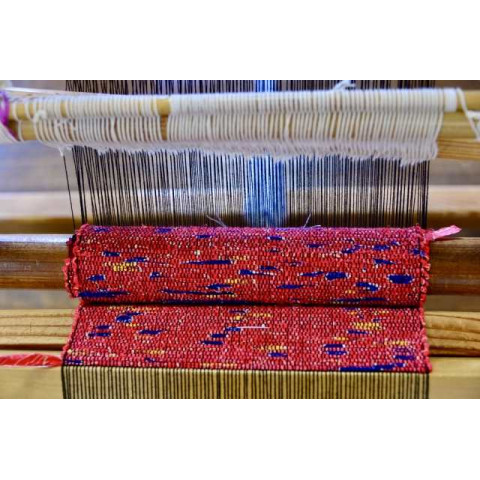
Sakiori is a traditional Japanese weaving technique that involves using strips of old cloth, such as kimono fabric or other textiles, to create new woven items. The word "sakiori" is derived from two Japanese words: "saki," meaning to tear or shred, and "ori," meaning to weave.
In the sakiori process, old textiles are torn or cut into narrow strips and then woven together to produce new fabric. These strips can be from various materials, including cotton, silk, or other fibres. The resulting woven fabric often has a rustic and textured appearance, with the different colours and patterns of the original cloth creating a unique and visually interesting effect.
Sakiori has historical roots in Japan, where it was used as a practical way to repurpose worn-out or damaged textiles. Over time, it has also become a traditional craft and a form of folk art. Today, sakiori weaving is sometimes practised as a hobby or artisanal craft, and the finished pieces may include items like rugs, bags, and clothing.
The origins of sakiori can be traced back to the Edo period (1603–1868) in Japan. During this time, Japan experienced a rigid class structure and a society heavily influenced by Confucian values. The majority of the population were farmers, and resources were often scarce. Clothing, especially textiles made from precious fibres like silk, was a valuable commodity.
As a practical response to limited resources, people developed sakiori as a way to repurpose worn-out or damaged clothing. Instead of discarding old textiles, individuals tore or cut them into strips and wove them together to create new fabric. This process allowed for the preservation of valuable materials and the creation of functional items such as floor coverings, blankets, and everyday clothing.
Sakiori weaving became a thrifty and sustainable practice, particularly in rural communities where the availability of new materials was limited. The resulting woven items had a distinctive appearance, with a mix of colours and textures from the various scraps of cloth used in the weaving process.
Over time, sakiori evolved not only as a practical solution but also as a traditional craft and a form of folk art. Artisans and craftspeople began to refine the technique, and sakiori items gained cultural significance as both practical and artistic creations.
In the modern era, sakiori continues to be practised as a traditional craft, and some artisans create contemporary pieces that blend historical techniques with new designs. The craft has also gained recognition beyond Japan, with an appreciation for its sustainable and artistic qualities. Today, sakiori items may include rugs, bags, clothing, and other woven goods, showcasing a fusion of history, culture, and craftsmanship.